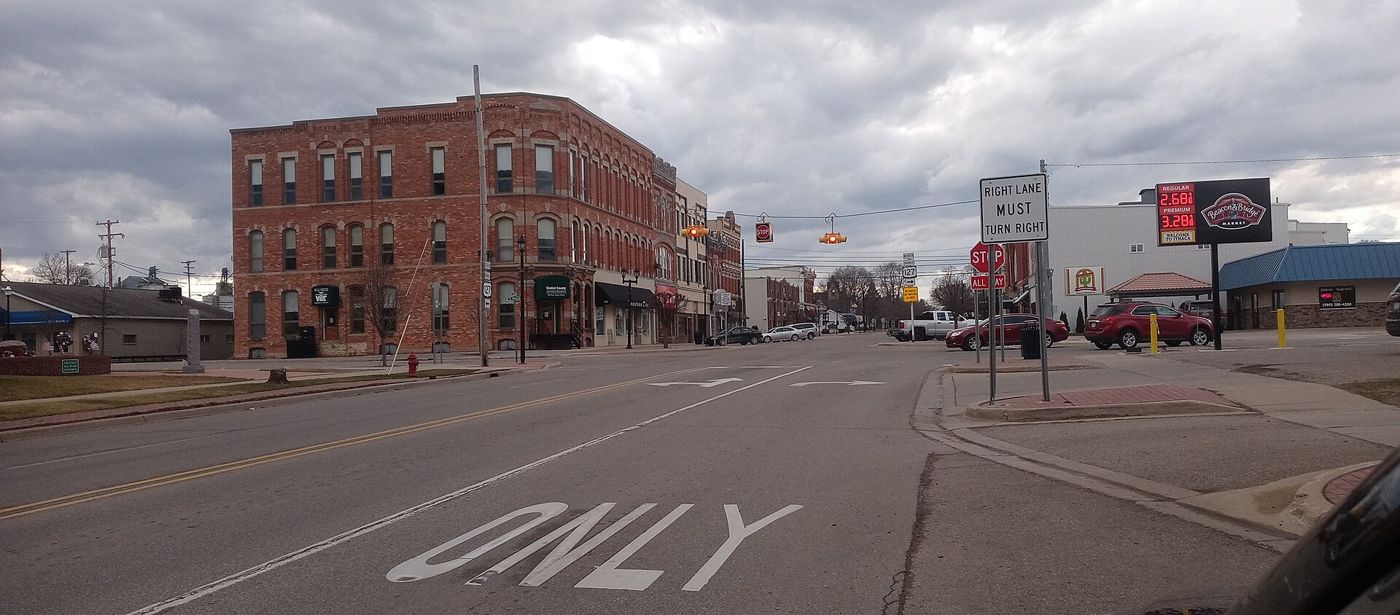
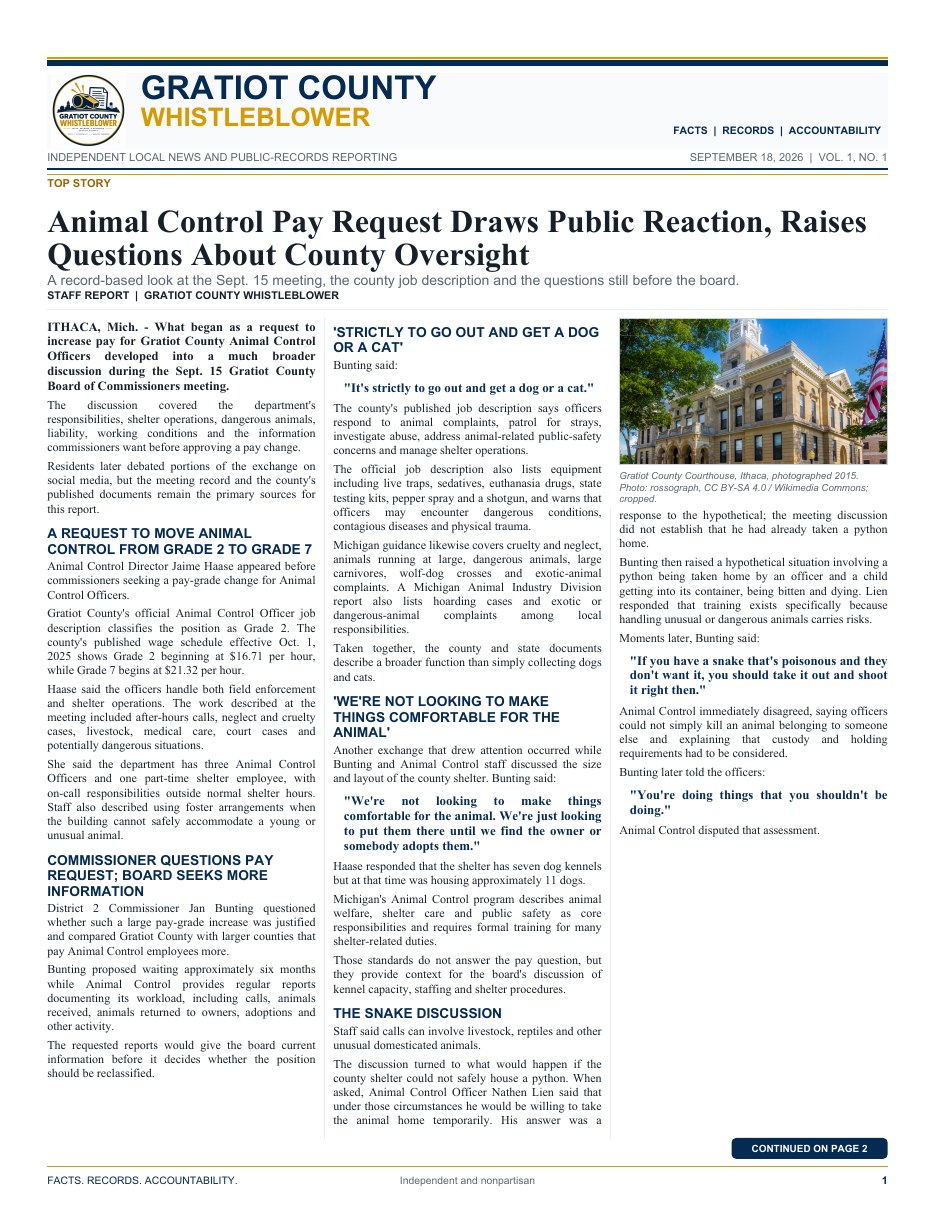
Gratiot County Courthouse, Ithaca. Photo: rossograph, CC BY-SA 4.0; cropped.
From our newsroom
News from across Gratiot County
Our coverage includes local people, education, public safety, events and community life alongside government accountability. Each original report identifies its sources and separates confirmed facts from what remains unknown.
Updated September 18, 2026
Local people & public safety
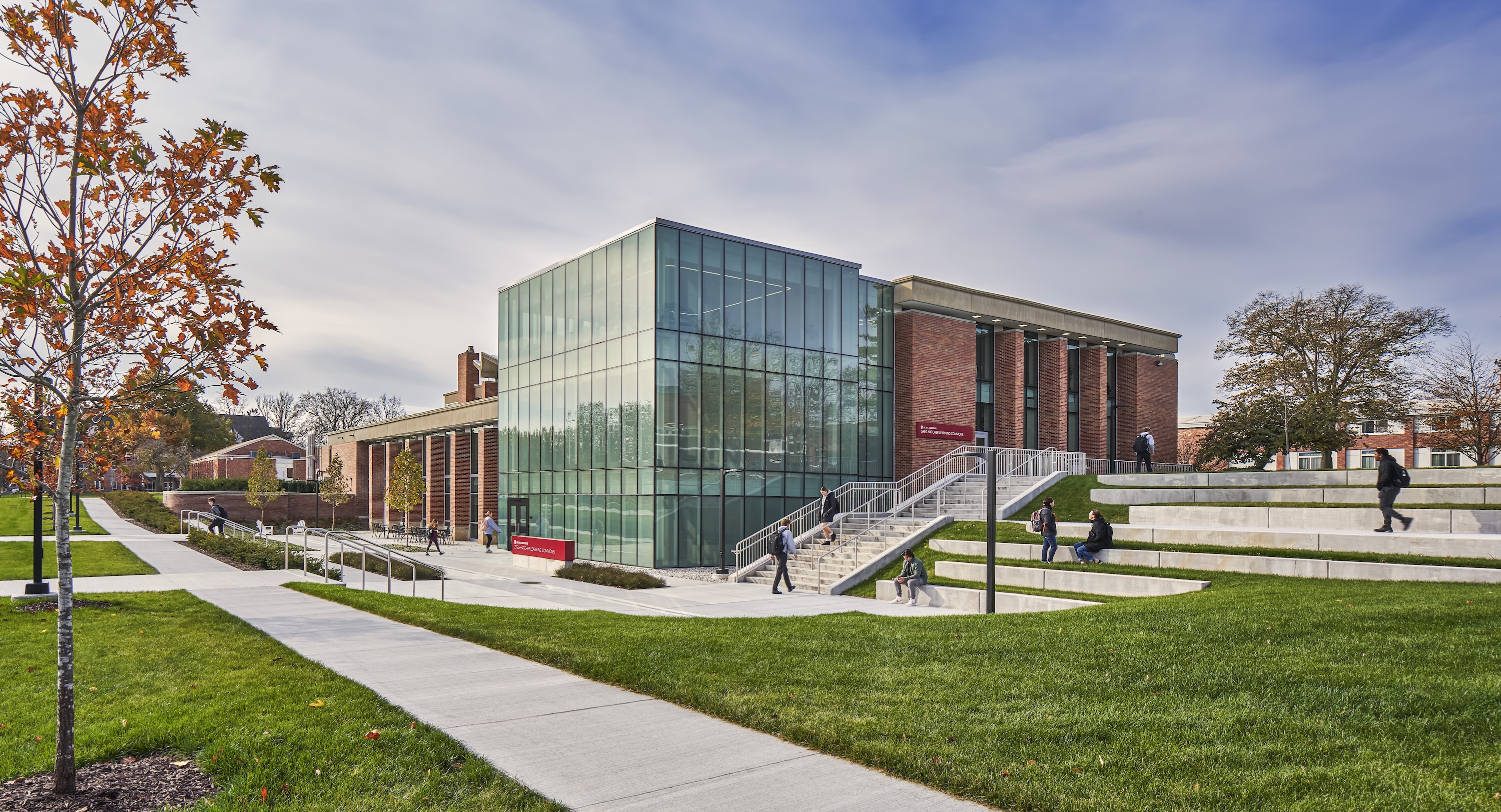
Greg Hatcher Learning Commons at Alma College. Jake Kelley graduated from Alma in 2024. Photo: Rathtj, CC BY-SA 4.0; cropped.
The self-taught cook and 2024 neuroscience graduate won the national competition after advancing through a season built around global cuisines and cultural heritage.
Read the full article
ALMA — Jake Kelley, an Alma College class of 2024 graduate who grew up in Hemlock, won Season 16 of MasterChef: Global Gauntlet in the finale broadcast Sept. 16.
Kelley finished ahead of fellow finalists Heidi Muston and Peter Egede. Coverage of the finale identifies the award as the MasterChef title, trophy and a $250,000 prize.
The season's judges were Gordon Ramsay, Tiffany Derry and Joe Bastianich. According to TV Insider's interview with Kelley, his three-course finale menu opened with a smoked appetizer he named for the kraken, the sea monster of legend, followed by a traditional mole served with octopus and a dessert of profiteroles with ice cream, coulis and ganache.
Alma College profiled Kelley in June while the competition was still underway. The college reported that he earned a neuroscience degree, taught himself to cook through online videos and used food to connect with classmates. Kelley represented his Mexican heritage during a season in which contestants drew on cultural traditions.
Mole was also how he got on the show. The college reported that his audition dish was a mole-inspired dessert: chocolate-chili ganache, almond sponge cake and a black sesame crème anglaise. Kelley told the college that Mexican cooking carries history and nuance that people do not always get to see.
His Alma years included the iGEM program, Student Congress, marching band and the rock climbing club. The college also reported that he worked as a pharmacy technician and was beginning to take private-chef clients while building restaurant experience.
He lived in Bruske and Newberry halls and joined the TKE fraternity, the college said, and cooking for other students became part of campus life. “It was one of the ways I met people,” he told the college.
The win changes his plans. TV Insider reported that Kelley set aside the idea of pharmacy school, moved to metro Detroit and joined the kitchen at Vecino, a Mexican restaurant that was named to a New York Times list of the best Mexican restaurants in the United States.
The two sources describe his roots slightly differently. Alma College identifies his hometown as Hemlock, in Saginaw County; TV Insider lists Alma. This article follows the college's account of where he grew up.
Road Commission workers made the discovery April 7 near Michigan Avenue. Public reports reviewed for this update did not identify the person or establish a cause or manner of death.
Read the full article
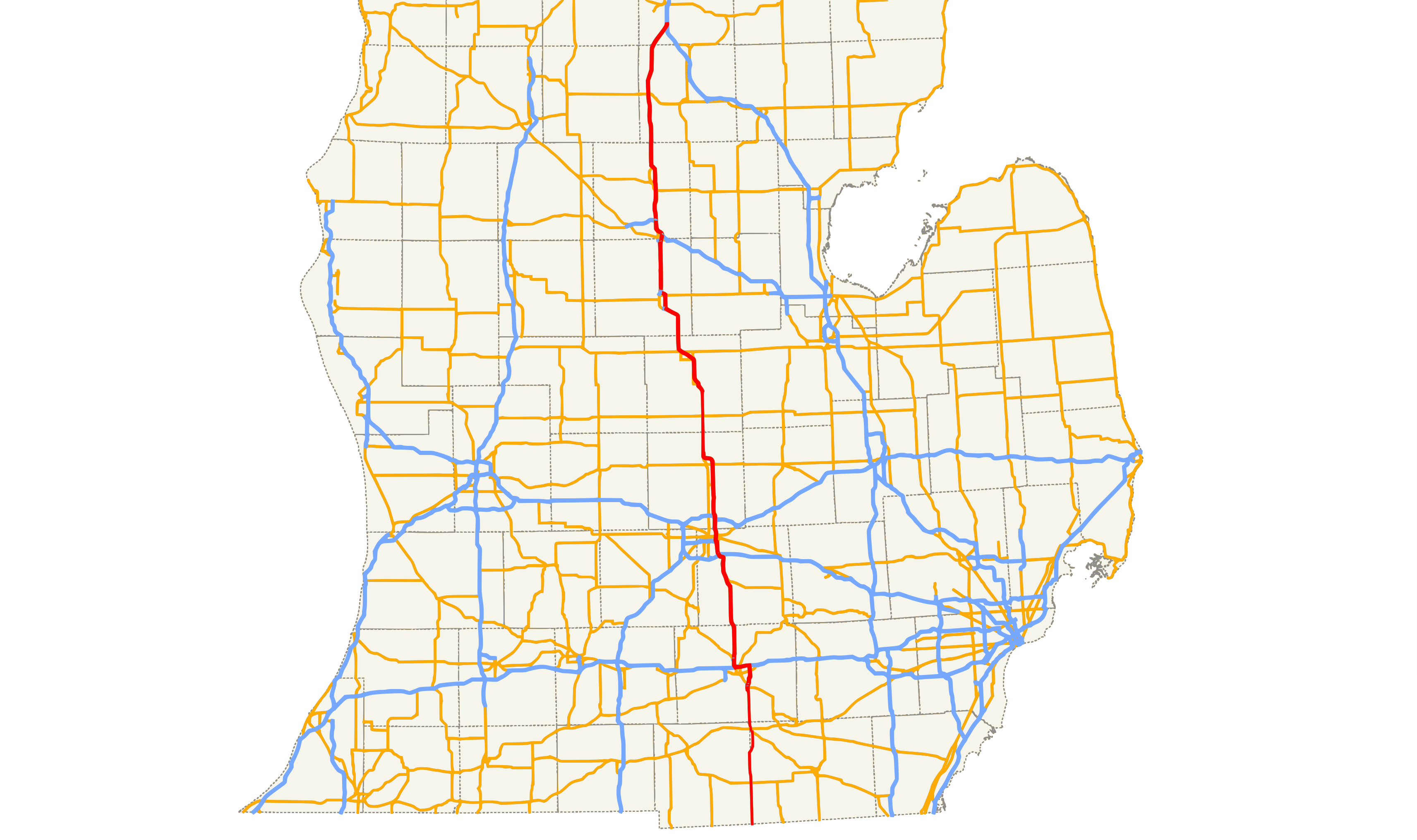
PINE RIVER TOWNSHIP — Gratiot County Road Commission employees found human remains April 7 while performing maintenance along northbound U.S. 127 near Michigan Avenue, according to reports based on information released by the Sheriff's Office.
The remains were found beyond the guardrail on the east side of the northbound lanes. Michigan State Police forensic personnel and a K-9 team assisted, and the Michigan State University Anthropology Unit confirmed the remains were human.
Authorities sent the remains to the Genesee County Medical Examiner's Office, working with the MSU unit, for examination and identification. Reports published in April said that work was continuing.
CBS News Detroit attributed the initial information to Sheriff Tom Clark's office. None of the April reports gave an estimate of how long the remains had been at the site, described their condition, or said whether investigators suspected a crime. None included a public request for tips.
In general, forensic anthropologists are brought in when remains cannot be identified by sight, and identification can then depend on dental records, DNA comparison and missing-person files, work that often takes months. That general practice is context; officials have not described the specifics of this case.
More than five months have passed since the discovery. This publication searched again on Sept. 19 and found the same April reports, with no later announcement from the Sheriff's Office or the medical examiner.
No conclusion about foul play, identity or circumstances should be drawn from the location alone. We will update this report if the Sheriff's Office, medical examiner or another responsible agency releases confirmed findings.
Alma College says total fall enrollment is five students higher than last year, while its full-time and transfer counts show larger gains.
1,229
Total students
+28
Full-time students
+27.3%
Transfer enrollment
Read the full article
ALMA — Alma College reported total fall 2026 enrollment of 1,229 students, an increase of five from fall 2025.
The college's Sept. 17 release says full-time enrollment increased by 28 students and undergraduate full-time-equivalent enrollment rose by 10.1. New undergraduate enrollment was described as stable.
Transfer enrollment increased 27.3%, according to the college. Alma also reported fall-to-fall re-enrollment rates of 82.4% for first-time students and 86% for transfer students.
The college described the 82.4% figure for first-time students as its second-highest in a decade. Re-enrollment measures how many students who started one fall came back the next.
President Joe Odenwald said in the release that the numbers show Alma can attract and keep students in a highly competitive environment. He pointed to graduate programs, transfer students and full-time enrollment as the areas of growth. The release does not give a separate head count for graduate students.
In August, Alma added a chemistry pathway with Montcalm Community College, joining accounting, business, communication and psychology routes that date to 2023.
A five-student gain is small next to a total of 1,229, a change of less than half of one percent. The larger movement is inside the total: more students attending full time, and more arriving from other colleges.
Alma's Ezekiel Baltierra took first in the boys Bronze Division race Sept. 11, according to MileSplit Michigan's published meet recap.
Read the full article
EAST LANSING — Ezekiel Baltierra of Alma won the boys Bronze Division, Division 2 race at the 2026 Spartan Invitational with a reported time of 16 minutes, 5 seconds.
MileSplit Michigan's race recap says Baltierra moved ahead early and won by 15 seconds. Petoskey won the team competition with 102 points; Alma finished second with 118.
In cross-country, a team's score is the sum of its top five runners' finishing places, so the lowest total wins. A 16-point gap means Petoskey's scoring runners finished, on average, about three places ahead of Alma's.
MileSplit credited Petoskey's win to a strong finish from its top two runners, Reeve Oberman and Jack Frentz, and called the result an upset based on preseason ratings that had Alma among the top five teams. The recap does not list places or times for those two runners.
The Sept. 11 meet was held at Forest Akers East Golf Course in East Lansing. Michigan State University hosted the 45th annual Spartan Invitational, which included college and high-school competition.
Students who finish an associate degree at Montcalm Community College now have a mapped two-year path to a chemistry bachelor's degree in Alma, the college says.
Read the full article
ALMA — Alma College and Montcalm Community College have added chemistry to the list of majors covered by their transfer agreement, the college announced Aug. 27.
Under the arrangement, a student completes an associate degree in arts or sciences at Montcalm, then transfers to Alma to finish a Bachelor of Science in chemistry. The college describes the Alma portion as two additional years.
The two schools have had a transfer agreement since 2023. Until now it covered four fields: accounting, business, communication and psychology. Chemistry is the first laboratory science on the list.
Alma says its chemistry program is approved by the American Chemical Society. Two Alma chemistry faculty members, associate professors James Mazzuca and Jeffrey Turk, are quoted in the announcement; Mazzuca said the agreement gives transfer students a clear direction.
The college describes a department built around laboratory work. According to the announcement, chemistry students do research alongside faculty, present at professional conferences and appear as co-authors on published papers. Turk called the department immersive.
For a student starting at Montcalm, which serves Montcalm County west of Gratiot, the arrangement means spending the first two years at a community college and knowing in advance what remains for the bachelor's degree. The college directs interested students to the Transfer Pathways page on its website.
The announcement arrives as the college reports growth among transfer students. In its separate fall enrollment release, Alma said transfer enrollment rose 27.3% from a year earlier.
Alma College has named its 2026 Tartan Award recipients and chosen Will Nichols, who conducted the college choirs for more than four decades, as parade grand marshal.
Read the full article
ALMA — Five Alma College graduates will receive Tartan Awards during Homecoming weekend, Sept. 25–26, the college announced. The awards are scheduled to be presented at a luncheon Saturday, Sept. 26.
The recipients, as listed by the college:
Amy McGinnis, class of 1992 — Hugh Brenneman Distinguished Alumni Award. McGinnis teaches in Central Michigan University's management department and directs student-engagement and leadership-scholar programs there. A first-generation college student, she earned a master's degree at Michigan State University and previously led human resources and communication work at Lansing Community College. The college notes six years on the West Midland Family Center board and teaching and advising awards from CMU.
Ryan Webb, class of 2000 — George and Bess (Brown) Hebert Award, which recognizes loyalty and service to the college. Webb has spent 25 years at Pfizer, where he is a team lead in cardiovascular marketing, and holds an MBA from the University of Michigan. At Alma he played four years of varsity soccer, on teams that won two conference championships, and three of tennis. He co-founded an endowed scholarship, the Eric M. Didocha Memorial Merit Award.
Brent Neubecker, class of 1995 — Smith Distinguished Service Award. Neubecker, who studied history and political science, is a former Alma College alumni director and annual fund director. He was a four-year baseball starter and captain, has been president of the Alma Kiwanis Club and coaches youth football, baseball and softball. The award is named for Art Smith, class of 1938, and Carra (Jones) Smith, class of 1942.
Libby Flatoff, class of 2021 — Young Alumni Award. Flatoff is a program and policy associate at the Arms Control Association in Washington, D.C., and holds a master's degree in nonproliferation and terrorism studies from the Middlebury Institute of International Studies. At Alma she competed in Model United Nations and on the swim team and studied in Peru and India.
Betsy Pilon, class of 2003 — Lynne Sherwood Women's Leadership Award. Pilon founded and leads Hope for HIE, a nonprofit the college says serves about 15,000 families worldwide affected by hypoxic ischemic encephalopathy, a form of infant brain injury. She co-founded a research registry for the condition and serves on national child-neurology panels. At Alma she played in the symphony orchestra and was part of the first dance team.
The Homecoming parade grand marshal is William “Will” Nichols, who led the Alma College choirs from 1983 to 2024. The college credits him with founding its Festival of Carols and leading 12 international choir tours along with more than 35 in the United States. Nichols holds a master's degree and a doctorate in music from Michigan State University. His wife, Pam, a retired Alma High School English teacher, traveled with the choirs.
A change in Ithaca's financing plan could lower the cost of issuing debt for the Union Street project, according to the city manager's written report. The public record available Friday morning did not yet show the result of a special council vote.
Bond plan
$4 million
Advisor cost
$30,850
Verified status
Vote result not posted
Read the full article
ITHACA — City Manager Jamey Conn reported that Ithaca planned to issue one $4 million Capital Improvement Bond for the Union Street project rather than combining that issue with a separate Michigan Transportation Fund bond.
According to Conn's Sept. 15 written report, municipal adviser Bedzinski and Company recommended the change after construction bids came in favorably. The report says one larger offering was expected to attract more bidders and a more favorable interest rate.
The change also affects the cost of the bond adviser. The report lists $30,850 for one issue, compared with $47,000 if the city proceeded with two. Ithaca also reported meeting with S&P Global as part of the credit-rating process.
Conn's report puts the adviser's fee at $23,500 per bond issue, which is how two issues would have reached $47,000. It says the decision was made with Bedzinski and Company and the law firm Miller Canfield, and that Conn, the city treasurer and another participant met with S&P Global to review the city's standing and receive a credit rating for the bond.
The report also gives a glimpse of the project itself: in a separate item about a possible Arcada Street repaving, Conn mentions an opportunity to narrow that road “as we are doing on Union Street.”
The city posted notice of a special council meeting for 8 a.m. Sept. 18 to consider a resolution authorizing the 2026 capital-improvement bonds. A scheduled vote is not the same as an adopted resolution.
A proposed policy would set prices for complete assessment and cemetery-data exports while leaving ordinary individual-record requests under existing public-record laws.
Read the full article
ST. LOUIS — Draft resolutions in the Sept. 15 City Council packet describe two standardized electronic data products and the fees that would apply to them.
Finance Director Bobbie Marr submitted the two items. The first, Resolution 2026-18, would adopt an Enhanced Access to Public Records Policy under a 1996 Michigan law, Public Act 462, which lets a public body offer bulk digital access to non-confidential records and charge reasonable fees meant to recover, over time, the operating costs of providing it. The law requires such a policy to be adopted first. The second, Resolution 2026-19, names the data products and sets the prices.
Marr's memo says the city periodically receives requests for large electronic exports of assessment, cemetery and financial-transaction information, and that recent requests showed the need for a consistent policy. It describes the policy as meant mainly for cases in which all of a database is requested, not specific records.
The proposal lists $1,000 for a complete Assessment/CAMA public-data export, $250 for another update during the same assessment year and $1,000 for a complete cemetery public-data export.
The packet distinguishes those bulk products from ordinary requests for individual assessment or cemetery records, which would continue to be handled under the Freedom of Information Act or other applicable law. Financial-management data would not yet be designated because the city's current export includes transactions processed for multiple entities.
The memo says the city receives requests for bulk accounts-payable data, generally every quarter. Staff would review whether an export limited to St. Louis transactions can be built and return to the council with any proposed fee.
Under the drafts, no database could carry an enhanced-access fee unless the council specifically designates it. Confidential or exempt information would be left out of any export, the city would supply data only in the format its systems produce, and it would not be required to build custom reports. The memo calls the prices consistent with those of other Michigan governments but names none, and it includes no calculation of the city's costs. The fee resolution would take effect on adoption.
Project 12-26 is open for responses through 11 a.m. Oct. 16. The notice starts a competitive process; it does not identify a selected provider or contract price.
Read the full article
GRATIOT COUNTY — The county published a request for proposals for opioid remediation services on Sept. 14, beginning a process that could lead to a future service contract.
The official posting identifies the solicitation as Project No. 12-26 and lists the Gratiot County administrator as the bid recipient. Responses are due by 11 a.m. Oct. 16; the posting says late responses will be disqualified.
The 26-page request for proposals says the money comes from national opioid settlements with drug distributors, manufacturers and pharmacy chains. It estimates Michigan's total at about $1.6 billion, split between the state and local governments, and says Gratiot County expects to have roughly $121,000 a year on average, an amount that will change from year to year.
Organizations working in prevention, harm reduction, treatment or recovery may apply. Among the conditions: the money must serve people in Gratiot County, must add to existing funding and not replace it, and no more than 15% may go to indirect costs. Recipients must meet with the county's Opioids Settlement Advisory Committee and join the Gratiot County Substance and Suicide Prevention Program.
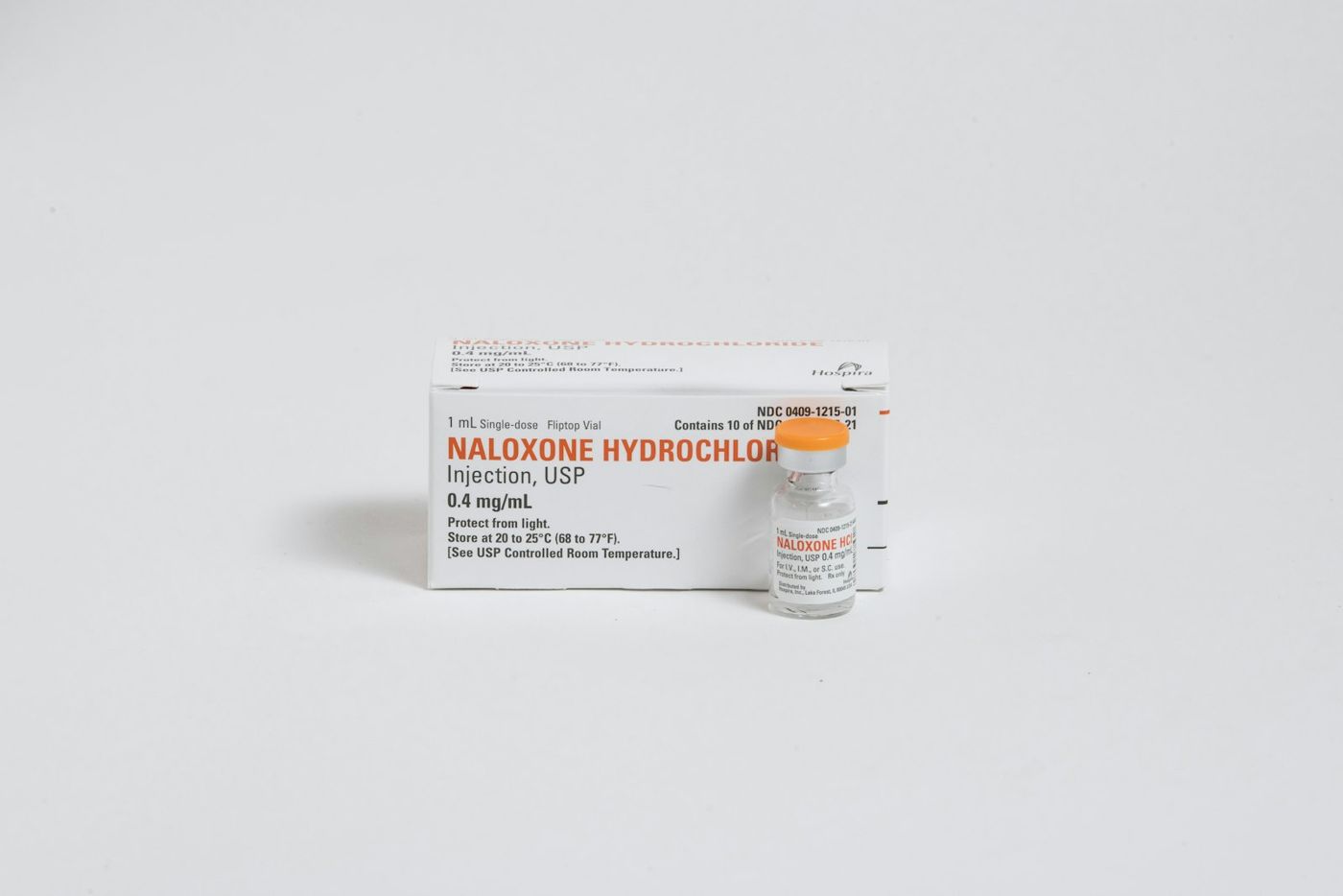
Allowed uses listed in the document include naloxone and other overdose-reversal drugs, medication-assisted treatment, services for pregnant and postpartum women, treatment for people in jail, prevention programs, syringe services and support for first responders.
The advisory committee will score proposals. Project description and scope of work each count for 25% of the score; measures of success and sustainability count for 10% each. Under the published timetable, selected organizations present to the committee Nov. 13, and the Board of Commissioners awards contracts Dec. 1. Funding would run at least from Jan. 1 through Dec. 31, 2027.
The document contains date errors that applicants should confirm with the county. Its timetable gives the question deadline and the answer date as Oct. 7 and Oct. 9, 2025, and another passage calls the Oct. 16, 2026, due date a Wednesday. That date falls on a Friday.
The request says the number of awards will depend on the money available. It does not establish how much any one organization will receive, which will be selected or whether a contract ultimately will be approved.
A draft resolution pairs a $50,000 National Fitness Campaign grant with a proposed $174,050 local commitment for an outdoor court intended to be free to the public.
Read the full article
ITHACA — The Sept. 15 council packet includes a draft resolution supporting an outdoor Fitness Court and confirming local money for the project.
The draft identifies a $50,000 National Fitness Campaign grant and $174,050 in local funding. It also says the city would need outside vendors for the concrete pad and assembly work.
Together the two figures come to $224,050, although the draft does not state a total project cost. It says added funding requirements for the concrete and assembly work are set out in a National Fitness Campaign requirements document attached to the grant.
The draft describes the National Fitness Campaign's 2026 effort as one that aims to place Fitness Courts in more than 1,000 municipalities and schools nationwide. The resolution commits the council to “funding/fundraising,” wording that leaves open whether the local share would come from the city budget, donors or both.
The draft does not name a site. The court is described as free to residents and visitors.
A separate county parks-grant application in the packet concerns the broader “Woodland Park: The Next Generation” project, but the requested amount is blank in the posted copy.
That application would go to the Gratiot County Board of Commissioners under the county parks millage, and it would authorize City Manager Jamey Conn to prepare and file it. Conn's written report in the same packet says new playground equipment is scheduled for installation beginning Oct. 12, with a pavilion remodel to start in early to mid-October. The packet's invoice list includes $3,497.59 for cameras at Woodland Park.
One clerical point: the agenda lists the fitness grant as Resolution 2026-15 and the parks application as 2026-16, while the draft documents themselves carry the opposite numbers.
Alma voters are scheduled to fill four City Commission seats Nov. 3, but the city's election page lists only three candidates who filed nominating petitions.
Read the full article
ALMA — Andrew Bare, Roxann Harrington and Danny Wernick filed to appear on the November ballot for four available City Commission seats, according to the city's official election page.
Because only three candidates filed, Alma says the commission contest did not appear on the Aug. 4 primary ballot and will instead appear at the Nov. 3 general election.
The filing deadline was April 21. The city lists four commissioners whose terms expire this year: Bare, Harrington, Wernick and Michelle Pitts. Pitts is not among those who filed, which is why one of the four seats has no candidate on the ballot.
Alma's commission has seven members elected at large. Voters do not choose the mayor directly; the commission appoints one of its members to preside over meetings and serve as the city's ceremonial head. Greg Mapes is mayor. Harrington is vice mayor and, according to her biography on the city's site, has served on the commission since January 2010.
The city says the three candidates receiving the most votes normally serve four-year terms, while the fourth-place candidate serves two years. With three names on the ballot for four seats, the fourth could be decided by write-in votes. The city directs anyone interested in filing a write-in declaration of intent to City Clerk Sara Anderson at 989-463-8336.
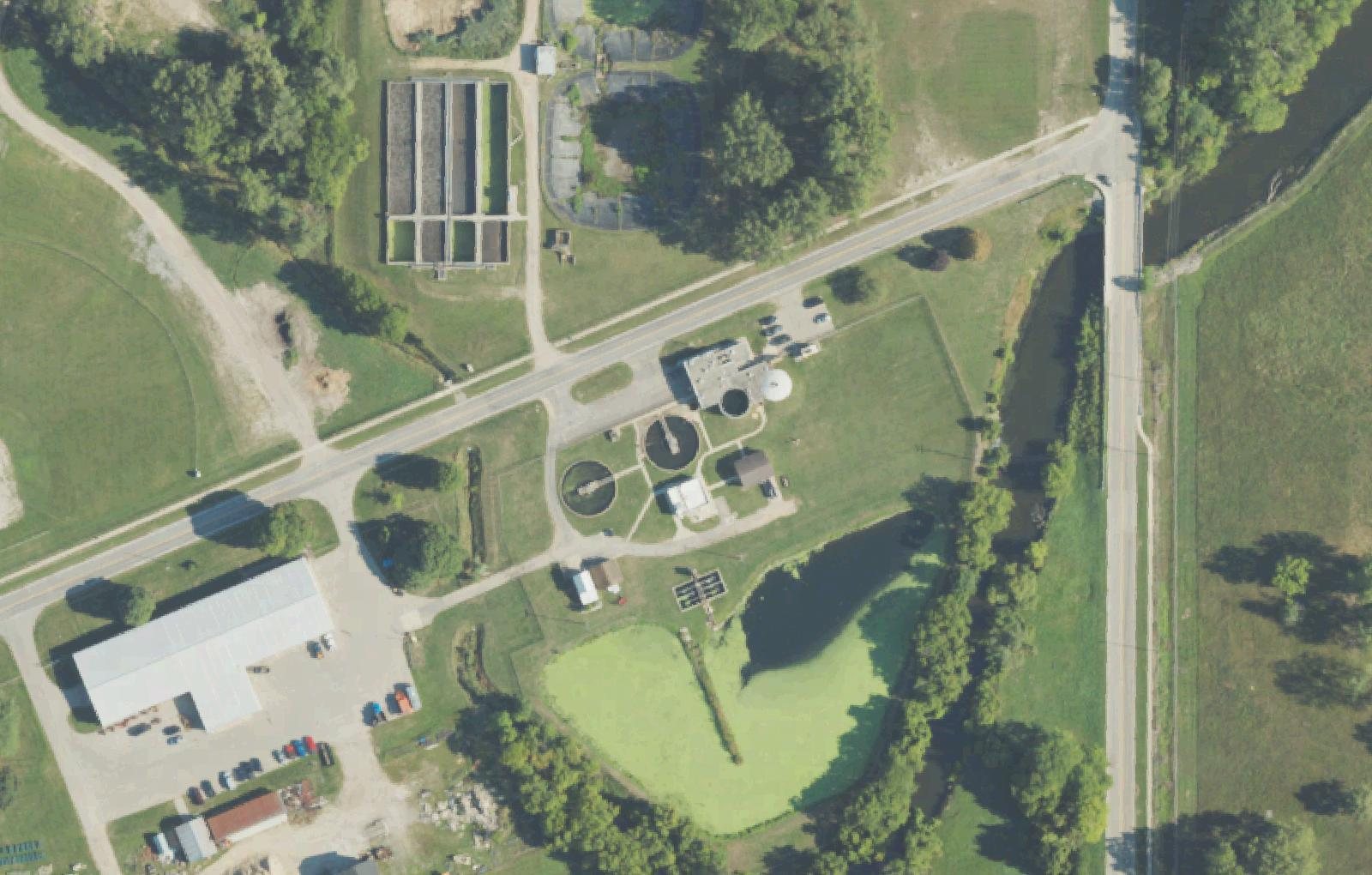
Alma's Wastewater Treatment Plant from the air, with its two round clarifiers at center and the polishing pond beside the Pine River. Image: USDA NAIP aerial imagery via the U.S. Geological Survey, public domain.
A city notice says the state has committed the full amount Alma sought to rebuild its wastewater treatment plant. The same notice shows that $34.8 million of the package must be repaid, and it says the funding will affect what sewer customers are charged.
Total package
$40 million
Loans to repay
$34.8 million
Forgiven principal
$5.2 million
Read the full article
ALMA — The City of Alma says Michigan's Clean Water State Revolving Fund will cover the entire $40 million the city requested for a complete rehabilitation of its wastewater treatment plant.
According to a public notice still featured on the city's website, the Michigan Department of Environment, Great Lakes, and Energy informed Alma on July 13 that additional money had been added to its application. The notice lists three pieces.
The largest is a traditional revolving-fund loan of $31,208,000, which the city says grew by $16,965,000. The second is a $3,592,000 loan through the federal Bipartisan Infrastructure Law, which did not change. The third is $5,200,000 in principal forgiveness, up by $2,535,000. Principal forgiveness is the portion a community does not have to pay back.
Added together, the two loans come to $34.8 million, or 87% of the package. The forgiven share is 13%.
The plant serves all of Alma and parts of Arcada and Pine River townships, according to the city's wastewater department. It is designed to treat 2.5 million gallons a day and averages about 2 million, releasing treated water to the Pine River.
The department describes the facility as an activated-sludge plant with extended aeration. Incoming wastewater is mixed with bacteria and aerated for about 24 hours, solids are separated in two final clarifiers, and the water is disinfected with chlorine before spending about 36 hours in a polishing pond. The city says treated water makes up slightly more than 1% of the Pine River's flow and meets state and federal discharge limits. The department also maintains 11 lift stations, and about 1 million gallons of liquid sludge is applied to farmland each year.
Sewer customers have already seen one increase this year. The department's page says the City Commission voted May 12 to raise the usage rate from $4.00 to $4.20 per 1,000 gallons, effective July 1. The page does not say whether that increase is tied to the plant project.
That distinction matters to ratepayers. The city's notice says the funding “will directly affect the rates that must be charged to system users,” and describes the loans as low-interest. It credits city staff and the engineering firm Fishbeck for work on the application.
The county posted a rain-delay notice Sept. 18 for EAA Chapter 134's fly-in and car meet. The new flyer lists Saturday, Sept. 26, 11 a.m. to 2 p.m., at Gratiot Community Airport, with free admission.
Alma's calendar lists the Solid Waste Authority on Sept. 21, City Commission on Sept. 22 and Downtown Development Authority on Sept. 30. Times or locations can change, so readers should verify the city calendar before attending.
Agendas and draft resolutions show what officials planned to discuss. Adopted minutes, signed resolutions and executed contracts show what actually happened. Our articles label that difference.
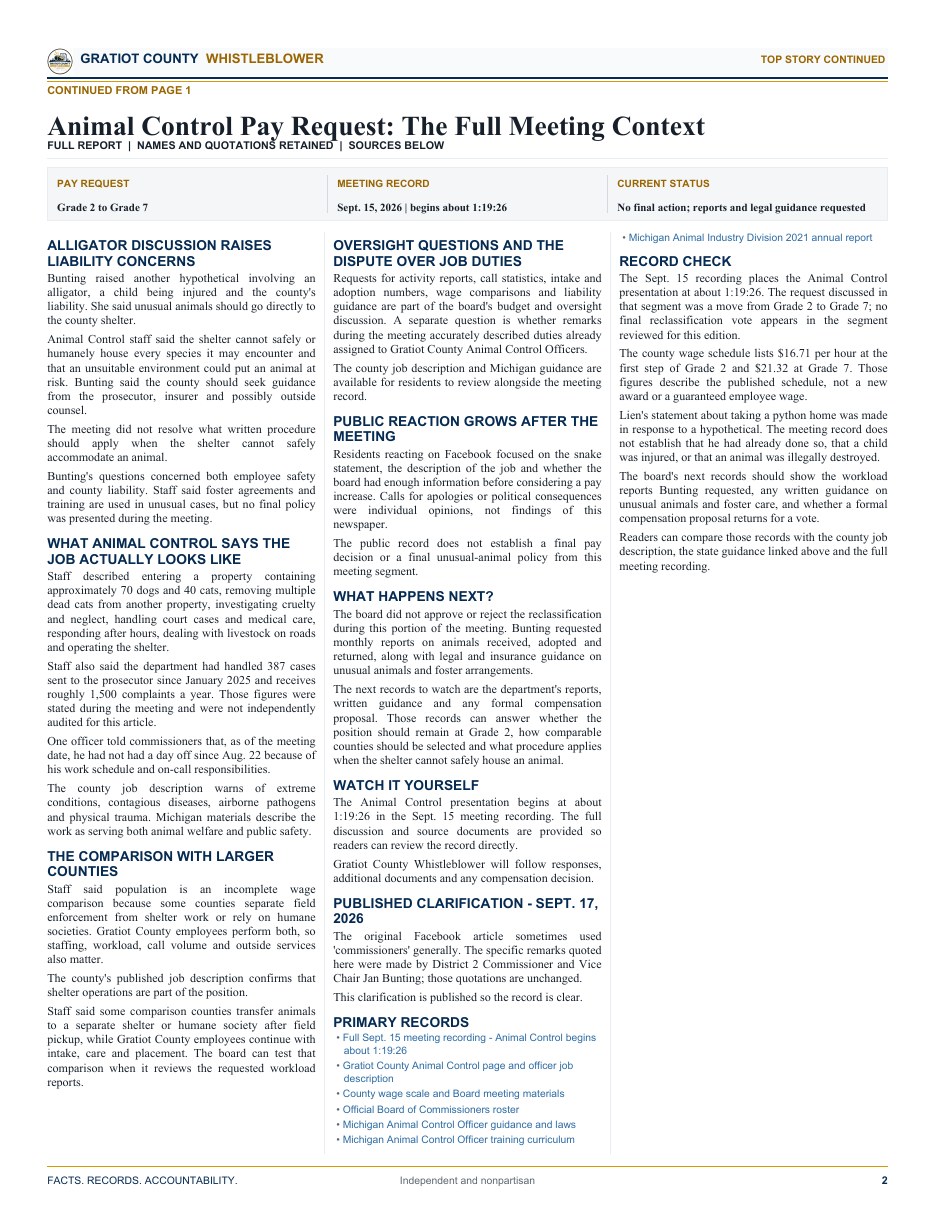
What began as a request to increase pay for Gratiot County Animal Control Officers developed into a broader discussion during the Sept. 15 Gratiot County Board of Commissioners meeting. The conversation covered department responsibilities, shelter operations, dangerous animals, liability, working conditions and the information commissioners want before approving a pay change.
Pay requestGrade 2 → Grade 7
Board actionNo final decision
Next recordWorkload reports
Animal Control Director Jaime Haase requested the reclassification. District 2 Commissioner Jan Bunting proposed waiting about six months while the department supplies regular activity reports. During a separate hypothetical discussion, Officer Nathen Lien said he would be willing to temporarily take home a python if the shelter could not safely house it; the meeting did not establish that he had previously done so.
Published clarification: The specific remarks quoted in the newspaper were made by District 2 Commissioner and Vice Chair Jan Bunting. The quotations are retained in the full edition so readers can compare the article with the meeting record.
Full reportRead the complete article
Meeting context, direct remarks and records to watch · about 8 minutes
The complete report
Animal Control pay request, meeting remarks and the questions still before the county
Staff report · Published September 18, 2026
A request to move Animal Control from Grade 2 to Grade 7
Animal Control Director Jaime Haase appeared before commissioners seeking a pay-grade change for Animal Control Officers. Gratiot County's official job description classifies the position as Grade 2. The wage schedule effective Oct. 1, 2025 lists Grade 2 beginning at $16.71 per hour and Grade 7 beginning at $21.32 per hour.
Haase said the officers do more than respond to calls in the field. They also help operate the county animal shelter. She said that some counties separate enforcement and shelter work, while Gratiot County employees perform responsibilities from both sides. The presentation described after-hours calls, neglect and cruelty cases, shelter duties, livestock, medical care, court cases and potentially dangerous situations.
Commissioners ask for more evidence
Bunting questioned whether the proposed increase was justified and compared Gratiot County with larger counties that pay Animal Control employees more. She proposed waiting approximately six months while the department provides regular reports documenting calls, animals received, returns to owners, adoptions and other activity.
Requests for workload reports, wage comparisons and liability guidance are part of the board's budget and oversight role. A separate question is whether remarks made during the discussion accurately described duties already assigned to the officers.
“Strictly to go out and get a dog or a cat”
During the discussion, Bunting described the job as “strictly to go out and get a dog or a cat.” The county's published job description is broader. It says officers respond to complaints, conduct patrols, pick up stray animals, investigate abuse, address animal-related concerns and manage shelter operations.
The job description lists equipment including live traps, sedatives, euthanasia drugs, state testing kits, pepper spray and a shotgun. It also warns that officers may encounter dangerous conditions, contagious diseases and physical trauma. Michigan guidance likewise describes animal control as including cruelty and neglect investigations, animals running at large, dangerous animals and other public-safety responsibilities.
Shelter conditions and animal care
While discussing the shelter, Bunting said, “We're not looking to make things comfortable for the animal. We're just looking to put them there until we find the owner or somebody adopts them.” Haase responded that the shelter has seven dog kennels and was housing approximately 11 dogs at the time.
The remark became part of the public response because shelter work includes animal welfare and care as well as containment. State requirements and training materials recognize shelter care and public safety as parts of the system.
The python question
The discussion turned to livestock, reptiles and other unusual domesticated animals. Staff explained that the shelter is not equipped to safely house every species and outside foster resources may sometimes be necessary.
Bunting raised a hypothetical situation involving a python being taken home by an officer and a child getting into its container. Officer Nathen Lien said that, in those circumstances, he would be willing to take the python home temporarily. His answer addressed the hypothetical; the meeting did not establish that he had previously taken a python home.
Bunting later said that if a snake were poisonous and unwanted, it should be taken out and shot. Animal Control staff disagreed, saying they could not simply kill an animal belonging to someone else and that custody and holding requirements had to be considered.
Alligator discussion raises a policy question
The discussion continued with a hypothetical involving an alligator and potential county liability if an employee took such an animal home. Staff said the shelter is not physically equipped to safely or humanely house every species and that an inappropriate environment could cause an animal to die.
The unresolved issue is what written procedure the county should use when Animal Control encounters an unusual domesticated animal that the shelter cannot safely accommodate. Bunting said the county should consult its insurance provider, prosecuting attorney and possibly other attorneys. The meeting segment did not resolve that question.
What officers said the job looks like
Staff described entering a property with approximately 70 dogs and 40 cats, removing multiple dead cats from another property, handling cruelty and neglect investigations, preparing court cases, providing animal medical care, responding after hours and dealing with livestock loose on roads.
One officer said that, as of the meeting date, he had not had a day off since Aug. 22 because of scheduling and on-call duties. Those descriptions can be compared with the county job description and future workload reports requested by the board.
Comparisons with larger counties
Commissioners compared Gratiot County wages with larger Michigan counties. Staff responded that population alone does not show whether departments perform equivalent work. Some counties have separate shelters, humane societies or other organizations that take over care after an officer delivers an animal. Gratiot employees said their small department performs field enforcement and substantial shelter work.
A useful comparison would therefore include staffing, call volume, shelter duties, workload and services performed by outside organizations—not population alone.
Public reaction and what happens next
After clips from the meeting circulated online, residents expressed differing views. Some focused on the snake remark and the description of the job as involving only dogs and cats. Others defended the board's request for more documentation before approving a significant wage change. Calls for apologies or political consequences are opinions of individual residents, not conclusions of this publication.
The board did not approve or reject the reclassification during the portion reviewed. Records to watch include the requested activity reports, written guidance for unusual animals and foster arrangements, legal or insurance advice, and any proposal returned for a formal vote.
Watch and review the record
The Animal Control presentation begins at approximately 1:19:26 in the Sept. 15 meeting recording. Readers can compare the discussion with the county job description, wage schedule and state Animal Control guidance linked beside this article.
Gratiot County Whistleblower will continue following official responses, additional records, compensation decisions and any clarification of Animal Control procedures.
The newspaper opens in a new tab. On a phone, saving the PDF may give the clearest full-page view.
County desk
Public money, programs and follow-up
Public money
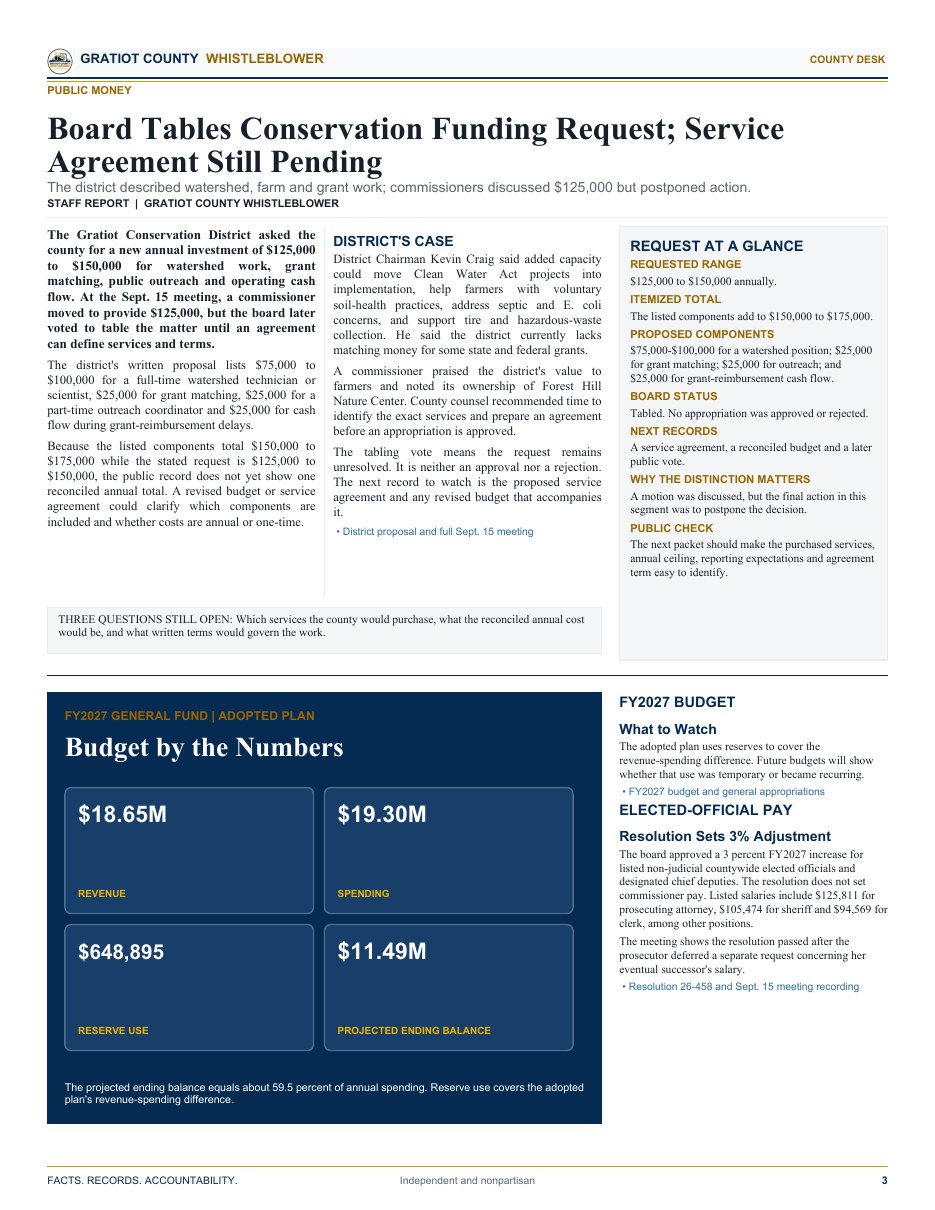
Board Tables Conservation Funding Request
The Gratiot Conservation District requested $125,000 to $150,000 annually. The listed components total $150,000 to $175,000. The board tabled the matter while a service agreement and reconciled budget are prepared.
Status: No appropriation was approved or rejected in the meeting segment.
Read more on this page
The figures presented do not yet produce one reconciled annual total. A revised budget or service agreement could clarify which components are included, which costs are annual or one-time, and what work the county would receive.
The next public record to watch is the version returned to the board for consideration. Until a formal vote occurs, the request remains tabled.
The projected ending balance equals about 59.5 percent of annual spending. Future budgets will show whether reserve use was temporary or recurring.
Read the budget context
The proposed general fund shows spending above revenue, with $648,895 in reserve use. The projected $11.49 million ending balance remains substantial in relation to annual spending.
One budget year does not establish a trend. Later budgets and audited financial statements will show whether the planned reserve use was temporary or became recurring.
Community results
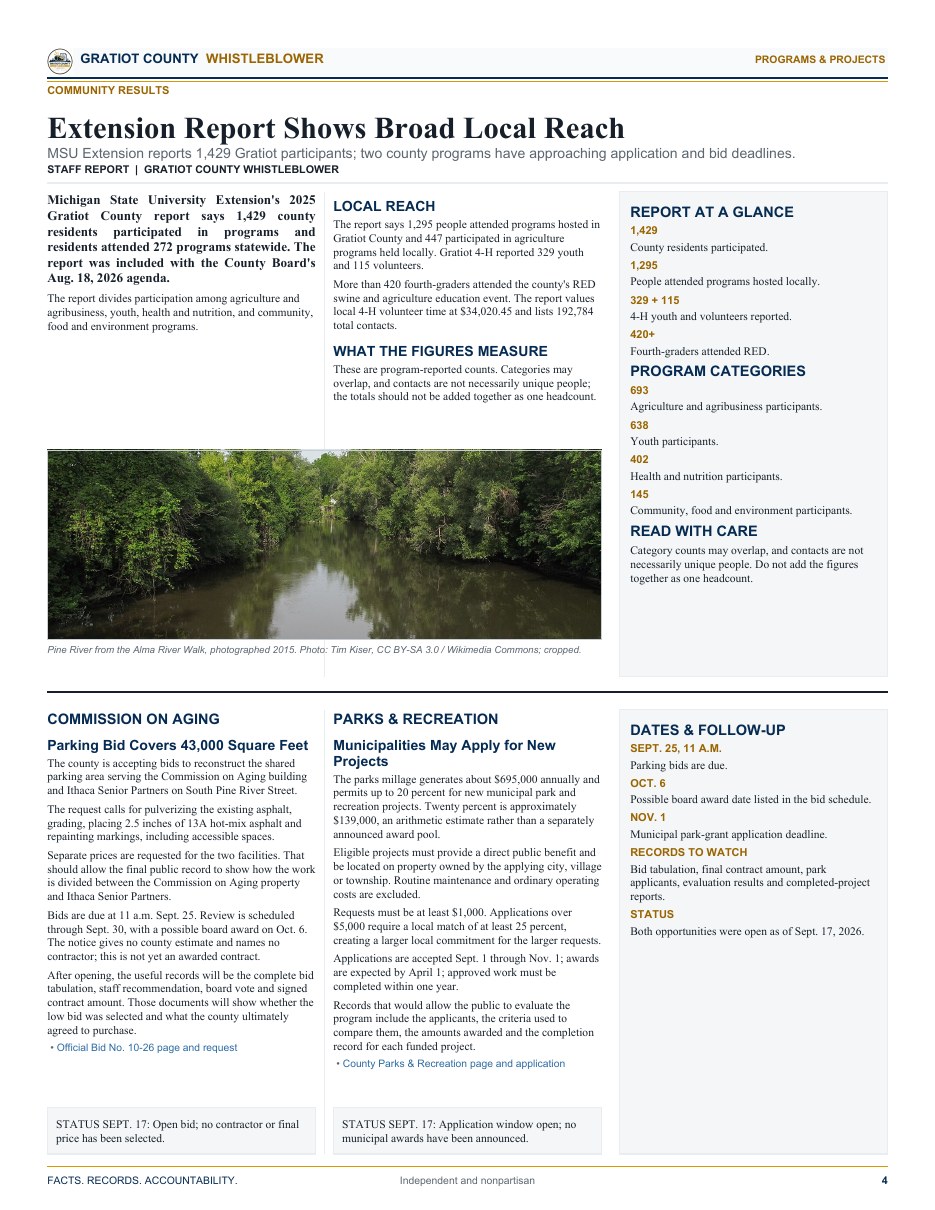
Extension Report Shows Broad Local Reach
MSU Extension reports 1,429 Gratiot County participants in 2025. Category counts may overlap and reported contacts are not necessarily unique people.
Read more on this page
The report describes participation across agriculture, youth development, health, nutrition and other programs. Its figures are the program's reported measures, not an independent audit.
To evaluate the results over time, readers can compare future reports for participation, spending, program reach and the definitions used for participants and contacts.
Pine River, Alma. Photo: Tim Kiser, CC BY-SA 3.0; cropped.
Commission on Aging
Parking Bid Covers 43,000 Square Feet
Bids are due at 11 a.m. Sept. 25, with a possible board award listed for Oct. 6. The notice names no contractor and gives no final contract price as of this edition.
What the notice establishes
The listed work covers approximately 43,000 square feet at the Commission on Aging property. The bid notice is a request for proposals, not evidence that a contractor or price has been selected.
The county says the application window runs Sept. 1 through Nov. 1. Requests over $5,000 require a local match of at least 25 percent.
What applicants should verify
Municipal applicants should review the county's current eligibility, matching-fund and submission requirements before relying on this summary. Any award depends on the county's review and approval process.
The board approved a 3 percent FY2027 increase for listed non-judicial countywide elected officials and designated chief deputies. The resolution does not set commissioner pay.
Read the distinction
The action applies to the positions listed in the resolution. It should not be described as a vote setting commissioner compensation because commissioner pay is not established by this measure.
The newspaper is one part of our work. This site is the running place for records, follow-ups and community responses that do not wait for a Friday edition.
01
Follow the record
We watch agendas, minutes, budgets, contracts, policies and meeting recordings for the next document that answers an open question.
02
Make room for responses
Officials, departments, organizations and residents can provide a response. Relevant replies are identified and added to the record.
03
Correct in public
If a fact, name, date or link needs correction, we update the story and explain what changed so the public record stays clear.
Dunning Memorial Chapel, Alma College. Photo: Santosdo, CC BY-SA 3.0; cropped.
Sept. 25–26
Alma College Homecoming
Alma College's 140th Homecoming celebration includes the Scot Trot 5K, Superior Street parade, football against Adrian and an evening choir concert. Some events require tickets or registration; check the college schedule for changes.
Postponed from Sept. 19 because of rain. EAA Chapter 134 now lists the event for 11 a.m. to 2 p.m. Saturday, Sept. 26, at Gratiot Community Airport, 3999 W. Seaman Road in Alma. Admission is free; the flyer lists a catered lunch at $12 for adults and $8 for ages 5–12.
Midland County residents may obtain vouchers for free passenger-tire disposal through Sept. 25. The published rules require Midland County identification. Gratiot residents should not assume they qualify.
Share a school success, a new job, a raise, a certification, a personal milestone, volunteer work, an athletic result or another accomplishment worth celebrating.
Earned an AStarted a new jobReceived a raiseFinished a certification
Live community feed
Recent achievements
Reviewed by an editor
New posts appear at the top. Scroll inside this box to browse recent achievements.
We are reviewing county records, the Class B dealer, university records and the legislation that followed. The report will separate what the documents establish from claims that still require verification.
About us
Independent reporting built around the record
Gratiot County Whistleblower is an independent local news and accountability page operated by a small group of individuals who have chosen to remain anonymous. Our purpose is to provide Gratiot County residents with accurate, documented and transparent information about what is happening in our community.
We cover local government, public meetings, public records, budgets and spending, community concerns, local developments and stories that deserve public attention—whether the news is positive, negative or somewhere in between.
Our goal is to give residents the records, context and verified information they need to decide for themselves—not to tell them what to think.
Reach out
Send a tip, correction or response
Use the form or message Gratiot County Whistleblower on Facebook. When possible, include the original record, a date, a location and a way to follow up. Clearly identify what you know firsthand and what still needs verification.